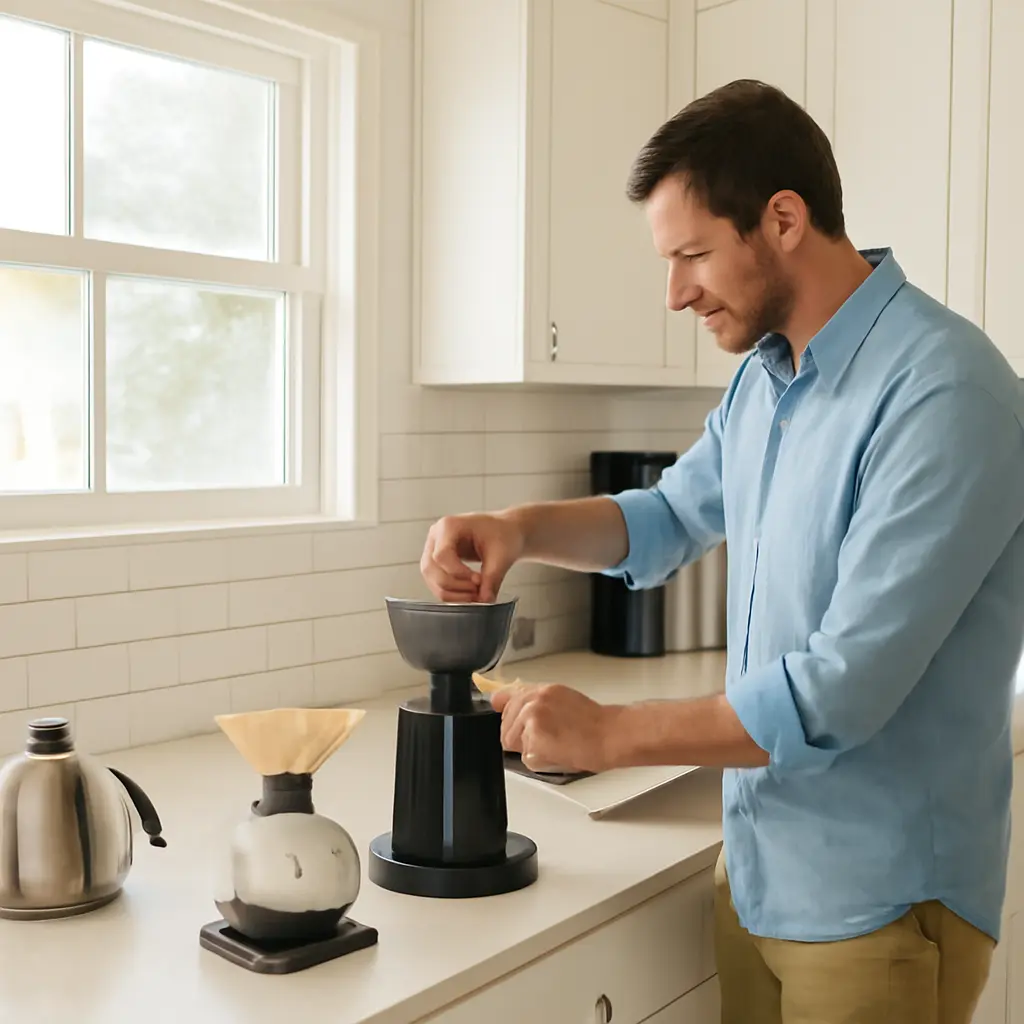
Grind size is the size and distribution of coffee particles produced by a grinder. It matters because particle size affects how quickly water extracts flavor: too fine a grind can make a brew harsh or slow, while too coarse a grind can leave it weak or sour. The Specialty Coffee Association’s brewing guidance treats grind, water, time, and coffee dose as connected variables, and research published in Scientific Reports has shown that particle-size distribution can influence extraction and cup-to-cup consistency. Understanding grind therefore helps explain why brew methods call for different settings, why uniformity matters, and how to troubleshoot a disappointing cup.
Grind size determines how coffee extraction behaves
Coffee extraction is the transfer of soluble compounds from ground coffee into water. The National Coffee Association describes brewing as water dissolving flavor compounds from the grounds; grind size affects how much coffee surface the water can reach and how easily it can flow through the bed. A finer grind exposes more surface area, which generally speeds extraction. A coarser grind exposes less surface area, usually slowing it down.
This does not mean finer is always better. Brewing is a balance: grind interacts with brew time, water temperature, agitation, coffee-to-water ratio, and equipment. If those variables are held constant, changing the grind can shift a cup from under-extracted—often thin, sharp, or sour—to over-extracted, which may taste dry, bitter, or harsh. These flavor descriptions are useful clues, not definitive diagnoses, because roast level and water chemistry also shape taste.
Surface area and extraction rate
Particle size changes the amount of coffee surface exposed to water. For particles of the same shape and total mass, breaking them into smaller pieces creates more total surface area. Water can therefore access soluble material more quickly in a fine grind than in a coarse one. Researchers at the University of Bath and colleagues, writing in Scientific Reports in 2020, examined how grind size and flow affected espresso extraction, demonstrating that particle size is an important factor in how evenly and efficiently a coffee bed is extracted.
Particle-size distribution and uniformity
A grinder does not produce particles of one exact size; it produces a distribution. A batch may contain the intended particles alongside smaller fragments called fines and larger fragments. Fines can extract rapidly and may migrate into or obstruct parts of a coffee bed, while larger particles extract more slowly. The result can be uneven: some portions may taste over-extracted as others remain under-extracted. A 2019 study in Scientific Reports by researchers including Christopher Hendon and colleagues explored how grind distribution and brewing conditions affect espresso extraction, underscoring why consistency matters in addition to the grinder’s nominal setting.
Brew method sets the useful grind-size range
A brew method’s contact time and flow pattern help determine which grind range works best. The Specialty Coffee Association’s Golden Cup guidance gives a general brewing benchmark of 55 grams of coffee per liter of water, with a target brew time of roughly four to six minutes for its specified brewing conditions. Those figures are not universal recipes, but they show how grind is considered alongside dose, water, and time. A method that holds water with coffee for longer generally needs a coarser starting point than a fast, pressurized method.
Fine grind: espresso and short-contact brewing
Fine grounds are commonly used for espresso, where hot water is pushed through a compact coffee bed under pressure over a short period. The fine particles provide resistance and help create an appropriate flow rate. If the grind is too fine for the dose and machine, water may flow too slowly or unevenly; if it is too coarse, the shot may run quickly and taste weak or sour. Espresso recipes must be adjusted to the machine, basket, coffee, and desired shot time rather than copied as a single fixed setting.
Medium grind: drip and pour-over brewing
Medium grinds are a common starting point for automatic drip machines and pour-over brewers. In these methods, water passes through a filter and coffee bed, so grind affects both extraction and drainage. A grind that is too fine can slow the drawdown and encourage a bitter or muddy cup; a grind that is too coarse can let water pass quickly and produce a weak brew. The right setting depends on filter shape, pouring technique, dose, and the brewer’s flow rate.
Coarse grind: immersion and cold brew
Coarse grounds are often used for French press and long-steep cold brew. Immersion keeps coffee and water together, so extraction can continue throughout the steep rather than relying only on water flowing through a bed. A coarser grind can make separation easier and limit excessive extraction during a long brew, although it does not eliminate the need to control steep time and ratio. Cold brew recipes vary substantially; there is no single grind setting or steep duration that suits every concentrate or ready-to-drink style.
Grind adjustment is a practical way to improve flavor
Once a recipe is reasonably consistent, grind is one of the most direct variables a home brewer can adjust. The Specialty Coffee Association’s brewing framework treats strength and extraction as distinct measurements: strength describes how concentrated the beverage is, while extraction describes how much soluble material has been removed from the grounds. A cup can be strong but under-extracted, or weak but over-extracted. Changing grind can alter extraction and flow, while changing the coffee-to-water ratio primarily changes beverage strength.
Use taste and brew behavior to guide changes
A simple troubleshooting approach is to keep the coffee dose, water, temperature, and method steady while changing grind in small steps. If a filtered coffee tastes sharply sour and drains unusually fast, try a slightly finer setting. If it tastes persistently harsh or dry and drains slowly, try a slightly coarser setting. For espresso, observe shot flow and taste together: a slow, choking shot may call for a coarser adjustment, while a fast, watery shot may call for a finer one. These are starting clues, not guaranteed fixes.
A repeatable test beats guesswork
Change one variable at a time and record the grinder setting, dose, water amount, brew time, and tasting notes. This makes it easier to tell whether an adjustment helped. For a pour-over, for example, keep the recipe fixed and compare two adjacent grinder settings. If the finer cup is sweeter and more balanced, continue cautiously in that direction; if it becomes dry or bitter, return toward the coarser setting. A refractometer can measure total dissolved solids, but careful sensory comparison is sufficient for many household brewing decisions.
Grinder quality and freshness affect grind consistency
Grind size is not only a dial setting. Burr design, grinder alignment, wear, and the production of fines all influence the resulting particles. Burr grinders generally provide more control over particle size than basic blade grinders, which chop beans less uniformly. However, grinder type alone does not guarantee a perfect cup: an appropriate setting, clean equipment, fresh coffee, and a repeatable recipe still matter.
Burr and blade grinders
Burr grinders crush beans between two surfaces, and the distance between those surfaces helps set the grind. Blade grinders use a spinning blade to break beans into pieces, with the result affected by grinding duration and how beans move in the chamber. For methods that are sensitive to flow, such as espresso and pour-over, a more consistent grinder can make dialing in easier. For casual brewing, a blade grinder may still be usable, but pulsing and shaking the grinder can help distribute particle sizes more evenly.
Fresh grinding and equipment care
Grinding shortly before brewing helps preserve coffee’s volatile aromas, which are gradually lost after beans are ground and exposed to air. The National Coffee Association recommends storing coffee in an airtight, opaque container in a cool, dry place and grinding just before brewing for best freshness. Grinder residue can also become stale and affect flavor; regular cleaning according to the manufacturer’s instructions helps prevent old oils and particles from building up. Changing beans may require a small grind adjustment, since origin, processing, roast, and age can alter how coffee behaves.
Conclusion: treat grind as a core brewing variable
Grind size matters because it changes surface area, extraction speed, and water flow, while particle-size distribution influences how evenly a brew develops. Fine, medium, and coarse settings serve different methods, but no setting works independently of recipe and equipment. For better coffee, begin with a method-appropriate grind, keep other variables steady, and make small adjustments guided by taste and brew behavior. If you want to learn more, compare one variable at a time and consult your brewer and grinder manufacturers’ guidance alongside the Specialty Coffee Association’s brewing resources.
Sources: Specialty Coffee Association, “The Coffee Brewing Control Chart” and Golden Cup brewing guidance, https://sca.coffee/research/coffee-standards; National Coffee Association, “How to Brew Coffee” and “How to Store Coffee,” https://www.ncausa.org/About-Coffee/How-to-Brew-Coffee; Cameron P. C. Hoffmann et al., “Systematically Improving Espresso: Insights from Mathematical Modeling and Experiment,” Scientific Reports, 2020, https://www.nature.com/articles/s41598-020-71387-4; Christopher H. Hendon et al., “The Role of Dissolved Gas in Espresso Crema Formation,” Scientific Reports, 2019, https://www.nature.com/articles/s41598-019-44223-9.