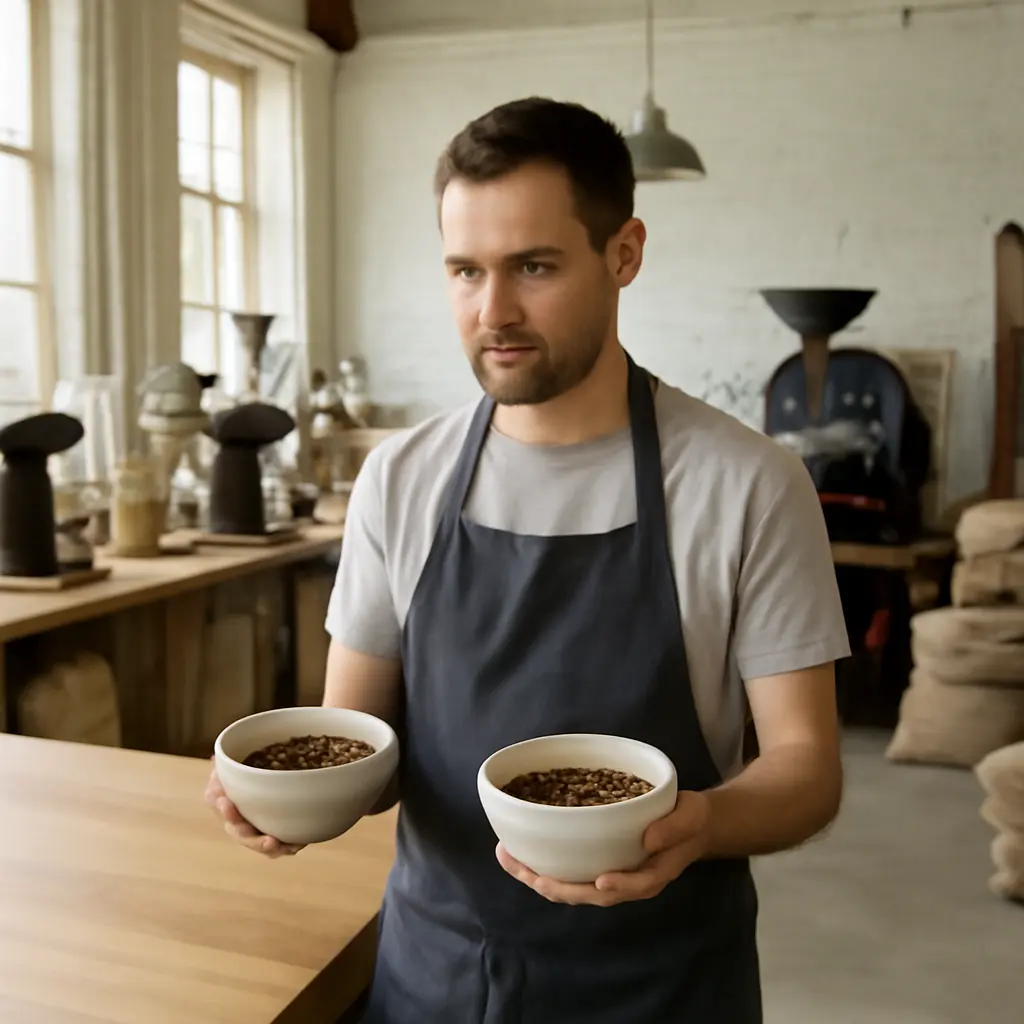
Specialty coffee blends combine beans from multiple origins, while single-origin coffees come from a stated geographic source such as a country, region, or farm. Neither label guarantees better quality: blends can be designed for consistency, balance, or value, and single-origins can express distinctive seasonal flavors—but origin names alone do not reveal a coffee’s grade, freshness, traceability, or flavor. The practical details behind the labels matter because coffee is a volatile global commodity: the International Coffee Organization reported world coffee exports of about 138.0 million 60-kilogram bags in coffee year 2023/24. Understanding how roasters define origins, build blends, disclose sourcing, and manage changing harvests helps consumers judge what a bag actually promises.
What blend and single-origin labels mean
A coffee blend is a product made by combining two or more coffees, commonly from different farms, regions, countries, species, or processing lots. A single-origin coffee is sourced from one identified geographic origin, but the term has no universally enforced boundary: one roaster may use it for a country, another for a cooperative, and another for a single farm or lot. The Specialty Coffee Association’s coffee vocabulary and the U.S. Food and Drug Administration’s general food-labeling rules do not establish one industry-wide definition that makes every “single-origin” claim equivalent.
That difference is important. “Single-origin” describes a sourcing scope, not a quality score or a guarantee that the coffee came from one tree, one harvest day, or one processing batch. “Blend” describes a combination, not necessarily lower-grade beans or a concealed origin. For consumers, the most useful questions are more specific: What does the roaster mean by origin? What is disclosed about the component coffees? How fresh is the roast? And does the flavor description match what is in the cup?
Single-origin coffee: a geographic claim with flexible boundaries
Single-origin coffee generally means that the coffee comes from one stated geographic area, but that area can range from a country to a particular farm, producer, or lot. A bag marked “Ethiopia” may contain coffee aggregated from multiple farms or washing stations; “Finca La Esperanza, Guatemala” makes a narrower claim. More precise sourcing can support traceability, but the label should be read alongside the roaster’s explanation of how the lot was selected and separated.
The U.S. Department of Agriculture’s National Organic Program illustrates why label terms need context: regulated claims such as “organic” have defined certification requirements, whereas “single-origin” is not a comparable federal grade or certification. A farm name or regional designation can be useful evidence of specificity, but it is not, by itself, proof of a particular score, ethical practice, or superior cup quality.
Coffee blends: a recipe that may change
A blend combines coffees to produce a target profile, such as sweetness, body, acidity, or suitability for espresso and milk drinks. Roasters may blend coffees before roasting, known as pre-blending, or roast components separately and combine them afterward, known as post-blending. These methods can produce different results, and the choice depends on the coffees’ density, moisture, roast behavior, and intended flavor.
Blend recipes can also shift as harvests arrive and stocks change. A roaster may substitute a coffee while trying to preserve the blend’s overall taste, especially for a year-round product. That is not automatically deceptive; it is a normal consequence of agricultural supply. But a blend described as containing named origins or farms is more informative when the roaster explains whether those components are fixed, seasonal, or subject to change.
Why roasters choose blends and single-origins
The choice between a blend and a single-origin often reflects different product goals rather than a simple quality hierarchy. A blend can be engineered for repeatability, while a single-origin can foreground the character of a particular harvest. Both depend on green-coffee quality, roasting skill, storage, and brewing. The Specialty Coffee Association’s cupping protocols provide a structured way to assess attributes such as fragrance, flavor, acidity, body, and balance; a product name alone cannot substitute for tasting or transparent sourcing information.
Consistency, balance, and commercial practicality
Blends can help roasters maintain a familiar flavor across different harvests by adjusting proportions or replacing components. They can also combine complementary characteristics—for example, a coffee with lively acidity and fruit notes with another that contributes sweetness or body. In cafés, a stable espresso blend can make daily dialing-in more manageable, although espresso results still vary with grinder settings, water, machine condition, and barista technique.
Consistency does not mean that a blend is identical forever. Coffee is an agricultural product, and crop conditions, harvest timing, processing, and shipping can all change the available components. The International Coffee Organization tracks a large international market rather than individual specialty lots, but its export figures illustrate the scale and movement of supply: roughly 138.0 million 60-kilogram bags were exported worldwide in coffee year 2023/24. A small specialty blend sits within that changing system.
Seasonality, distinction, and the appeal of a single lot
Single-origin offerings let roasters showcase differences among growing regions, varieties, elevations, and processing methods. A washed coffee may taste cleaner and more transparent to some drinkers, while a natural-processed coffee may show more pronounced fruit character; neither description is a guarantee, and actual flavor depends on the specific lot and roast. A named farm or lot can also make it easier for customers to follow a producer’s coffee across harvests, provided the roaster supplies meaningful sourcing details.
The trade-off is availability. A single lot may sell out or change with the next harvest, and a coffee’s sensory profile can differ from year to year. “Seasonal” is therefore not merely a marketing adjective; it can reflect the agricultural calendar and finite lot size. For buyers who value exploration and traceability, this variability can be part of the appeal. For those who want the same cup every morning, a well-managed blend may be more suitable.
What specialty roasters may leave unclear
The label is only the start of the story. A bag can communicate an origin and tasting notes while leaving unanswered how much the roaster paid, who produced the coffee, how the lot was assembled, or whether the blend changed. Those omissions do not prove wrongdoing: commercial contracts, confidentiality, and limited package space can constrain disclosure. They do mean that consumers should distinguish verified information from promotional language.
Tasting notes are descriptions, not guarantees
Tasting notes such as “stone fruit,” “chocolate,” or “floral” are sensory comparisons used to describe perceived aromas and flavors. They do not mean that those ingredients were added. Perception varies with brewing, water chemistry, roast development, and the drinker. A note is most useful when it is specific enough to set expectations and when the coffee’s roast date and brewing guidance are also available.
The Specialty Coffee Association’s cupping framework separates sensory evaluation into attributes rather than treating a single flavor note as a complete quality verdict. For a consumer, the practical test is whether the coffee tastes balanced and appealing when brewed as intended. If the advertised notes seem absent, that may reflect brewing or palate differences, but it is also reasonable to ask the roaster how the description was developed.
Origin detail is not the same as traceability
Traceability means being able to follow a coffee through relevant stages of its supply chain and connect it to identifiable producers, lots, or transactions. A country name offers less detail than a cooperative, washing station, farm, and harvest year. Even highly specific naming does not automatically disclose the price paid to producers or the terms of the relationship. A useful sourcing page explains what is known, what is aggregated, and what cannot be shared.
The International Trade Centre’s Coffee Guide describes coffee supply chains as involving producers, intermediaries, exporters, importers, and roasters. That chain helps explain why “direct trade” can be imprecise if a roaster does not define the term. Consumers can look for concrete information—producer or cooperative names, harvest details, processing method, and sourcing-period context—rather than relying on an appealing but undefined claim.
Price, quality, and ethical claims need separate evidence
A higher retail price does not establish that a coffee is better or that producers received more. Price also reflects roast scale, packaging, freight, import costs, labor, rent, and business margins. Likewise, “specialty” is not a universal consumer-facing certification that verifies every ethical or environmental claim on a bag. Buyers should look for the specific evidence behind claims—such as a named certification, published sourcing policy, or disclosed purchasing information—and understand what that evidence does and does not cover.
For context, Fairtrade International’s standards and the USDA Organic rules apply to defined programs and requirements; they are not interchangeable with a roaster’s general statement that coffee is “responsibly sourced.” Certifications can provide a structured standard, but they do not answer every question about quality, farm income, or long-term relationships. Transparent disclosure is therefore more informative than a broad claim without explanation.
How to choose between a blend and a single-origin
The best choice depends on how you brew, what flavors you enjoy, and how much variation you welcome. A useful comparison is to buy a blend and a single-origin from the same roaster, check their roast dates, and brew them with the same water and method. This controls some variables and makes it easier to judge the coffees themselves rather than the packaging.
- Choose a blend if you value a familiar, balanced profile or want a coffee designed for espresso and milk drinks.
- Choose a single-origin if you want to explore a particular region, producer, processing method, or seasonal lot.
- Check for a roast date, not just a “best before” date, and follow the roaster’s recommended resting period.
- Look for the level of origin detail: country, region, cooperative or washing station, farm, lot, and harvest where available.
- Ask whether a blend’s named components are fixed or may change, and whether the roaster publishes sourcing or purchasing information.
A practical tasting comparison
For a simple home comparison, use the same grinder, water, ratio, and brew temperature for both coffees. Record aroma, sweetness, acidity, body, finish, and whether the cup remains enjoyable as it cools. If one coffee tastes flat or harsh, adjust the grind and extraction before concluding that the origin or blend is at fault. A basic tasting chart can list the two coffees in columns and those six attributes in rows, helping separate preference from assumptions about the label.
For espresso, compare the coffees using the same dose and beverage ratio, then adjust grind to achieve a suitable extraction. A blend that tastes balanced as espresso may be less expressive as a filter brew; a delicate single-origin may shine in a pour-over but become difficult to distinguish in a milk drink. Matching the coffee to the brewing method is often more useful than treating one category as universally superior.
Conclusion: judge the coffee, not just the label
Blends and single-origins answer different questions: a blend describes coffee combined to pursue a target profile, while single-origin describes a stated geographic scope whose exact boundaries vary by roaster. Blends can offer balance and continuity; single-origins can highlight place, producer, and season. Neither label independently proves freshness, quality, traceability, or producer benefit.
To see beyond the marketing, check the roast date, ask how precisely the origin is defined, look for evidence behind sourcing claims, and taste the coffee using a consistent method. If a roaster’s description is vague, ask what the term means for that particular bag. The more specific the answer, the easier it is to choose coffee that fits your preferences—and to support businesses willing to explain how their products are made.
Sources: Specialty Coffee Association, Coffee Standards and Cupping Protocols, https://sca.coffee/research/coffee-standards; International Coffee Organization, Coffee Market Report, September 2024, https://www.ico.org/documents/cy2023-24/cmr-0924-e.pdf; U.S. Food and Drug Administration, Food Labeling Guide, https://www.fda.gov/regulatory-information/search-fda-guidance-documents/guidance-industry-food-labeling-guide; USDA Agricultural Marketing Service, National Organic Program, https://www.ams.usda.gov/about-ams/programs-offices/national-organic-program; International Trade Centre, The Coffee Guide, https://www.intracen.org/resources/publications/the-coffee-guide; Fairtrade International, Fairtrade Standards, https://www.fairtrade.net/standard.