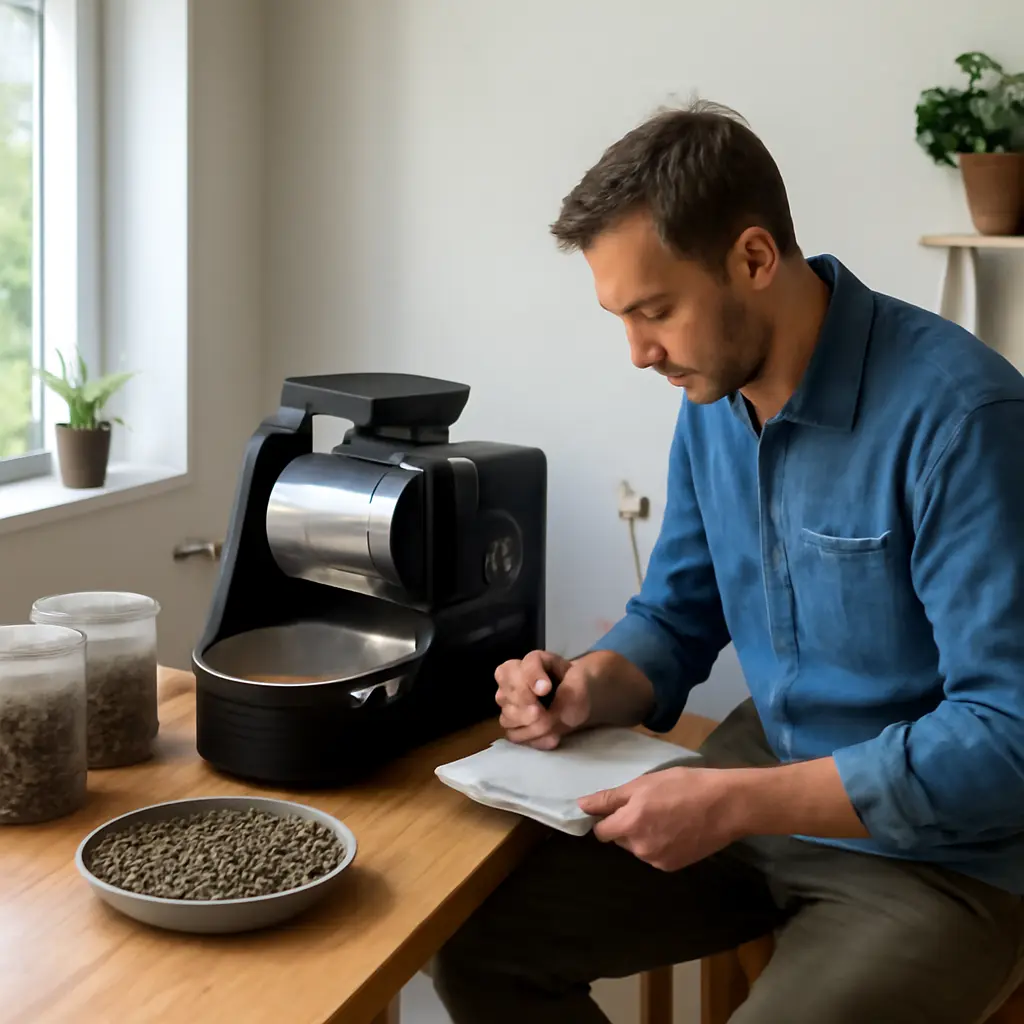
Commercial coffee roasters use heat, airflow, time, and sensory judgment to turn green beans into roasted coffee; they do not rely on one universal secret formula. Their most useful techniques are often hard for home brewers to reproduce because commercial machines offer precise control, repeatable batch records, and fast feedback, while home equipment varies widely. The Specialty Coffee Association’s roasting education and the National Coffee Association’s consumer guidance help explain the fundamentals, but practical gaps remain: batch size, probe placement, airflow, roast development, and cooling all affect results. Understanding those differences makes it easier to adapt professional methods safely and improve consistency at home.
Commercial Roasting Techniques and Their Practical Advantages
A commercial roasting technique is a repeatable method for applying heat and managing airflow to produce a desired flavor profile. The Specialty Coffee Association (SCA) describes coffee roasting as a process of physical and chemical change in which green coffee develops its aroma, color, and flavor. In practice, professional roasters combine machine settings with bean data and sensory checks rather than treating a roast curve as a recipe that works identically everywhere.
The techniques are not necessarily concealed. Roasters publish educational material, and many share roast profiles or explain their approach. What is difficult to copy is the full production system behind a cup: calibrated equipment, consistent green coffee, trained operators, and records from previous batches. The main technique categories include heat and airflow management, profile design, quality control, and post-roast handling.
Heat Transfer and Airflow Control
Heat reaches coffee through conduction, convection, and radiation. In a drum roaster, beans contact the heated drum while hot air circulates around them; fluid-bed roasters rely more heavily on moving hot air. Commercial operators adjust burner output and airflow to influence how quickly beans warm, how smoke and chaff leave the roasting chamber, and how heat continues to move through the batch.
Home machines may provide fewer controls, and their temperature readings may not correspond directly to bean temperature. A probe measures conditions at its location, not every bean in the chamber. Consequently, copying a commercial setting—such as a particular exhaust temperature or fan percentage—without the same roaster can lead to a different result.
Roast Profiles and Development
A roast profile is a recorded sequence of time and temperature observations, often paired with burner and airflow adjustments. Roasters commonly note drying, the first audible “cracks” as beans expand, and the period after first crack, called development. These milestones help describe a roast, but they are not universal timers: bean variety, density, moisture, batch size, machine design, and starting temperature can all change when they occur.
The SCA’s Coffee Value Assessment framework underscores that coffee quality is evaluated through multiple attributes rather than roast color alone. For a home roaster, this means using a profile as a starting point and checking the brewed coffee for sweetness, acidity, bitterness, body, and clarity. A curve that looks professional is not proof that the coffee tastes balanced.
Batch Records and Repeatability
Commercial roasting depends on repeatability: operators record green-coffee lot, batch weight, machine settings, time, temperature readings, and sensory outcomes. These records make it possible to compare batches and identify whether a change improved or harmed the result. The National Coffee Association notes that coffee flavor is affected by factors across the supply chain, including origin, processing, storage, and preparation; roasting is only one part of that chain.
This data discipline is available to home brewers even when commercial machinery is not. A notebook or spreadsheet with bean name, roast date, batch size, key events, cooling method, and tasting notes can reveal patterns more reliably than memory. That record-keeping leads naturally to the next professional advantage: systematic tasting and quality control.
Quality Control Connects Roast Decisions to Cup Results
Quality control in roasting means checking whether a batch meets a defined sensory and physical target, then using the findings to guide future production. Roasters may inspect color, look for defects, compare samples, and conduct cupping, a standardized tasting practice. These steps help distinguish a genuinely improved roast from one that merely looks darker or produces a more dramatic aroma.
Cupping and Sensory Evaluation
Cupping is a structured way to compare coffees by grinding, steeping, smelling, and tasting samples under consistent conditions. The SCA provides protocols for sensory assessment, including controlled sample preparation and evaluation. Professional cupping helps a roaster detect defects and compare how a profile expresses a coffee’s character, while home brewers can adapt the principle by tasting small samples side by side with the same water, grind, and brew method.
A useful home comparison changes one variable at a time. For example, roast the same green coffee in two small batches with different development times, then brew them identically. This does not reproduce a laboratory panel, but it reduces confounding factors and makes the flavor difference easier to interpret.
Color, Moisture, and Defect Checks
Roasters use physical inspection as a complement to tasting. Bean color can indicate roast progression, but color alone cannot reveal whether the center is adequately developed or whether the batch has unevenly roasted beans. Moisture and density also matter because green coffees with different physical properties respond differently to heat.
Commercial equipment may include more sophisticated measurement tools, but the underlying lesson is practical: compare like with like. Keep green coffee stored consistently, weigh batches, allow roasted coffee to rest under similar conditions, and examine samples for obvious scorching, tipping, or uneven color. These checks make sensory results more actionable.
What Home Brewers Can Adapt—and What They Should Not Copy Blindly
Home brewers can borrow professional habits without assuming that commercial settings transfer directly. The strongest adaptations are careful measurement, repeatable testing, appropriate cooling, and attention to safety. A small domestic roaster has different thermal behavior and capacity from a production machine, so professional numbers are best treated as reference points rather than instructions.
Cooling and Post-Roast Handling
Cooling quickly after the roast helps limit continued cooking from retained heat. Commercial roasters commonly use cooling trays and agitation to bring beans down in temperature; home users should follow the roaster manufacturer’s directions and avoid methods that create a fire or burn hazard. Chaff and hot beans should be handled away from combustible materials, and roasting should take place with suitable ventilation.
After cooling, coffee releases carbon dioxide, so it may taste different immediately after roasting than after a rest. The ideal rest depends on the coffee, roast, and brewing method. Rather than assuming a fixed number of days, taste the coffee at intervals and record when it becomes most balanced for the intended preparation.
A Simple Home Roasting Experiment
A controlled experiment can reveal more than an attempt to imitate a large roaster’s curve. Choose one green coffee, keep the batch weight constant, and vary one factor—such as total roast time or airflow—while recording the events. Then allow both batches to rest for the same period and brew them with the same recipe.
- Record the coffee’s origin or lot, batch weight, and starting conditions.
- Note elapsed time and available temperature readings at regular intervals.
- Mark visible color changes and audible first crack, if present.
- Cool both batches consistently and label them clearly.
- Compare them by smell and taste using the same brewing method.
This approach turns roasting into a learnable process rather than a search for a hidden “best” setting. It also reflects the professional principle that a change should be evaluated against a clear baseline.
Conclusion: Professional Methods Are Systems, Not Secrets
Commercial roasting techniques combine heat and airflow control, profile records, sensory evaluation, and consistent post-roast handling. Their advantage is less a single guarded trick than the ability to measure and repeat decisions across batches. Home brewers can apply the same logic by documenting roasts, controlling comparisons, tasting systematically, and treating commercial profiles as machine-specific examples rather than universal formulas.
For further learning, consult the Specialty Coffee Association’s roasting and sensory resources, review the National Coffee Association’s consumer education, and test one variable at a time with your own equipment. A careful notebook and consistent tasting are often more useful than chasing an unexplained professional setting.
Sources: Specialty Coffee Association, Coffee Value Assessment, https://sca.coffee/research/coffee-value-assessment; Specialty Coffee Association, Coffee Skills Program: Roasting, https://education.sca.coffee/coffee-skills-program; Specialty Coffee Association, Cupping Protocols, https://sca.coffee/research/protocols-best-practices; National Coffee Association, Coffee Roasts, https://www.ncausa.org/About-Coffee/Coffee-Roasts; National Coffee Association, Coffee Storage, https://www.ncausa.org/About-Coffee/Coffee-Storage