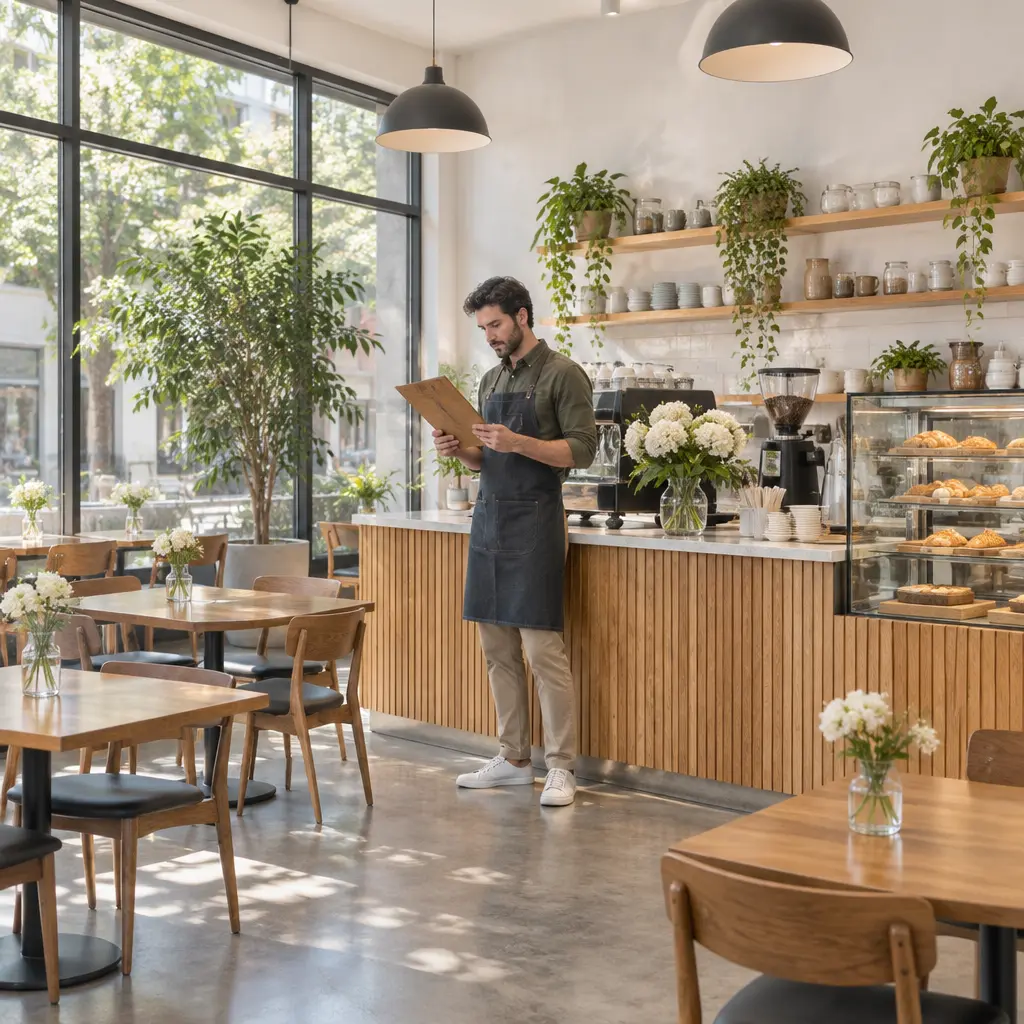
A café menu is the carefully designed list of food and drinks a business offers, with each item communicating value to customers while contributing to sales and operating costs. A menu that sells well balances customer appeal, achievable food costs, kitchen capacity, and clear pricing. The National Restaurant Association’s 2024 industry report identified persistent cost pressures for operators, making disciplined menu planning especially relevant. This guide explains how to use menu engineering, profitable item selection, pricing, and ongoing measurement to build a café menu that attracts customers without letting costs run away.
Menu engineering improves café menu profitability
Menu engineering is the structured analysis of menu items using sales volume and contribution margin—the money left from an item’s selling price after its direct ingredient cost. Hospitality researchers Michael Kasavana and Donald Smith developed a widely used menu-analysis approach that compares an item’s popularity with its profitability. The method helps cafés make evidence-based decisions instead of relying only on intuition or sales totals.
A useful starting measure is contribution margin: selling price minus the cost of ingredients used for one serving. For example, a $9 sandwich with $3 in ingredients contributes $6 toward labor, rent, utilities, and other expenses. That $6 is not net profit; it is a way to compare the item’s contribution with other menu choices.
Classify items by popularity and contribution margin
A café can group menu items into four practical categories by comparing each item’s sales and contribution margin with menu averages. These labels guide action; they do not replace judgment about brand fit, customer expectations, or preparation constraints.
- Stars: Popular items with above-average contribution margins. Keep them visible, consistent, and well supplied.
- Plowhorses: Popular items with lower-than-average margins. Review portion size, ingredient costs, and price sensitivity before changing them.
- Puzzles: Higher-margin items with low sales. Improve their descriptions, placement, staff recommendations, or appeal.
- Dogs: Items with both low sales and low margins. Consider revising, replacing, or removing them after checking whether they serve an important customer need.
A chart plotting popularity against contribution margin can make these categories easy to spot. Use a consistent period—such as four to eight weeks—and exclude unusual closures or one-off events where possible. Square’s restaurant menu-engineering guidance similarly emphasizes comparing item performance and margin rather than treating sales volume alone as proof of profitability.
Calculate recipe costs and contribution margin
Recipe costing assigns a cost to the actual quantity of each ingredient in a standard serving. Record purchase prices, usable yields, portion sizes, and garnishes; then total the recipe cost. A product’s purchase price is not always its usable cost: trimming, cooking loss, and spoilage can reduce the amount available to serve.
For example, if a soup serving uses $1.35 of ingredients and sells for $6.50, its contribution margin is $5.15. If rising dairy prices increase the recipe cost, the café can test a supplier change, recipe adjustment, portion change, or price update. The U.S. Department of Agriculture’s food-price reporting documents continuing variation across food categories, underscoring why recipe costs should be refreshed when supplier prices change rather than set once and forgotten.
Use sales mix to understand what customers choose
Sales mix is the proportion of total sales represented by each menu item. It reveals whether a café’s most popular products are also supporting its financial goals. Point-of-sale reports can show units sold, revenue, discounts, and time-of-day patterns; combining those records with recipe costs gives a more useful picture than revenue alone.
For instance, a high-volume latte may bring customers in, while a well-priced pastry adds to the average transaction. Track combinations as well as individual items, and distinguish dine-in, takeaway, and delivery orders when their packaging or platform costs differ. Once performance is visible, the next challenge is shaping a menu whose range and ingredients are manageable.
Menu assortment controls café menu complexity and waste
Menu assortment is the range of products and variations offered. A thoughtful assortment gives customers meaningful choice while limiting the number of ingredients, preparation steps, and slow-moving stock the kitchen must manage. The U.S. Environmental Protection Agency estimates that food waste accounts for a substantial share of municipal solid waste, while its food-waste guidance encourages businesses to prevent waste before relying on disposal or recovery. For a café, prevention begins with buying and preparing closer to real demand.
Build a compact core menu around shared ingredients
A core menu is the reliable set of items available most days. Design it around ingredients that can serve several dishes without making the menu feel repetitive—for example, roasted vegetables used in a grain bowl, sandwich, and breakfast hash. Shared ingredients can improve purchasing efficiency and reduce the chance that a single dish leaves a perishable ingredient unused.
Keep flexibility purposeful. A small number of seasonal specials can add variety, but each special should use available equipment and ingredients or have a clear sales case. Before adding a product, check whether it requires a new supplier, storage space, tool, staff skill, or preparation station.
Standardize portions and recipes
A standardized recipe specifies ingredients, quantities, preparation steps, yield, serving size, and presentation. Portion tools such as scales, scoops, and measured pumps help staff deliver a consistent product and keep ingredient use close to the costing assumptions. Without standards, a few extra ounces of cheese or coffee in each serving can quietly erode margins over time.
Train the team on substitutions and customizations, too. If a customer requests an alternative milk or extra protein, the point-of-sale setup should apply the correct charge and the recipe guidance should state the permitted portion. Clear standards also make it easier to compare actual inventory use with theoretical use.
Manage inventory with demand and spoilage in mind
Inventory management means ordering, storing, rotating, and counting ingredients so the café can serve its menu without tying up too much cash or letting products expire. Use first-in, first-out rotation, date labels, regular stock counts, and purchase records. Compare actual usage with recipe-based expected usage to investigate over-portioning, spoilage, recording errors, or untracked staff meals.
A simple waste log can record the ingredient, quantity, reason, and estimated cost of discarded food. Review it weekly and look for recurring causes, such as overproduction late in the day or a low-selling item with a short shelf life. The U.S. Environmental Protection Agency’s food-recovery hierarchy places source reduction first, making prevention—through better forecasting and menu design—a more direct response than treating waste only after it occurs.
Pricing and menu presentation shape café menu sales
Menu pricing sets the amount customers pay and determines how much each sale contributes toward operating expenses. A price should reflect ingredient cost, labor and service realities, competitor context, customer expectations, and the value the café offers. Food-cost percentage—ingredient cost divided by selling price—is one useful indicator, but it should not be mistaken for profit because it excludes other expenses.
Set prices using costs, value, and customer context
Start with a current recipe cost, then assess the price customers are likely to accept for the portion, quality, convenience, and setting. A cost-based calculation can flag items that cannot meet a target margin, while competitor checks and customer feedback help test whether a proposed price fits the local market. Do not assume one target food-cost percentage suits every product: beverages, baked goods, and labor-intensive dishes can have different cost structures.
Review prices when supplier costs, wages, portions, or demand shift materially. The Bureau of Labor Statistics’ Consumer Price Index tracks price changes across consumer categories and provides broader inflation context, but a café still needs its own invoices and recipe costs to make item-level decisions. When possible, test price changes on a limited number of items and monitor units sold, revenue, and contribution margin—not just customer reactions.
Write descriptions that explain the value
A menu description is a short explanation of an item’s ingredients, preparation, and distinctive appeal. Specific language helps customers understand what they are ordering: “slow-roasted tomato and basil on toasted sourdough” is more informative than “house special.” Descriptions should be accurate, concise, and consistent with what the kitchen can deliver.
Use descriptions to clarify options that matter, such as vegetarian ingredients, spice level, or available size. Avoid unsupported claims and make allergen information easy to find. The U.S. Food and Drug Administration identifies nine major food allergens for U.S. labeling purposes; cafés should establish reliable procedures for communicating allergen information and preventing cross-contact, while following applicable local requirements.
Organize the menu for fast, informed choices
Menu layout is the way products are grouped and presented in print, on a board, or online. Use clear categories, readable type, consistent naming, and prices that are easy to understand. Highlighting a few items can direct attention, but excessive boxes, icons, and promotional language can make decisions harder. Ensure digital and physical menus match, including availability, modifiers, and prices.
Menu psychology can support discovery, but it should not substitute for sound products or fair pricing. Place signature and high-contribution items where customers can find them naturally, and train staff to recommend suitable pairings without pressure. With the menu in place, regular measurement helps determine whether those choices are working.
Menu performance measurement sustains café menu results
Menu performance measurement is the repeated review of sales, costs, waste, and customer response to guide decisions. It turns a menu from a one-time design project into an operating tool. A café can begin with a weekly dashboard and refine it as its point-of-sale and inventory records improve.
Track a small set of useful metrics
Choose measures that lead to action rather than collecting data for its own sake. Useful indicators include units sold by item, contribution margin, food-cost percentage, average transaction value, add-on attachment rate, stockouts, and the value of recorded waste. Compare like periods—weekday with weekday, or season with the same season—because weather, holidays, and local events can distort short-term patterns.
A simple monthly chart can show sales volume and contribution margin by item, alongside a separate trend for waste. If a popular item’s margin falls, investigate recipe and supplier costs. If a profitable item’s sales lag, test its description, placement, visibility, or staff familiarity before removing it.
Run controlled menu tests
A menu test changes one meaningful factor at a time—such as a description, price, portion, or placement—then compares results with a suitable baseline. Record the test period and any relevant conditions, including promotions and stock availability. A small café may not have enough traffic for formal statistical certainty, but consistent tracking still reduces guesswork.
For example, a café could feature a high-margin seasonal muffin on its counter sign for two weeks and compare sales with similar weeks when it was not featured. If sales rise but waste rises faster, production quantities may need adjustment. Keep tests aligned with customer trust: do not disguise price changes, ingredients, or portion differences.
Use customer and staff feedback alongside data
Customer feedback reveals friction that sales reports may miss, including confusing descriptions, dietary needs, portion expectations, and unavailable favorites. Staff feedback can identify slow preparation, awkward equipment bottlenecks, and frequent substitutions. Combine these observations with sales and cost data; one complaint or one unusually busy day is not, by itself, a reason to redesign the menu.
A practical review cycle is to check sales and waste weekly, recost recipes when prices or portions change, and conduct a broader menu review each season. Document the decision for each item—retain, promote, reprice, reformulate, or retire—so that changes can be evaluated later.
Conclusion: design the café menu as a measurable business tool
A café menu sells and controls costs when its items are chosen and managed with both customer appeal and contribution margin in view. Menu engineering identifies stars, plowhorses, puzzles, and dogs; recipe costing and sales-mix analysis reveal what each item contributes; a focused assortment, standardized portions, and careful inventory reduce complexity and waste. Clear pricing, helpful descriptions, and consistent menu presentation make value easier for customers to understand.
Start by costing every recipe and reviewing recent sales, then make one or two measurable improvements rather than changing the entire menu at once. Keep tracking margin, demand, and waste, and revisit decisions as costs and customer preferences shift. For further guidance, consult the National Restaurant Association’s industry research, the FDA’s food-allergen resources, and the EPA’s food-waste prevention guidance.
Sources: National Restaurant Association, 2024 State of the Restaurant Industry Report, https://restaurant.org/research-and-media/research/research-reports/state-of-the-restaurant-industry/; Kasavana, Michael L., and Donald I. Smith, Menu Engineering: A Practical Guide to Menu Analysis, https://www.restaurantowner.com/public/Menu-Engineering-A-Practical-Guide-to-Menu-Analysis.cfm; Square, Menu Engineering: How to Create a Profitable Restaurant Menu, https://squareup.com/us/en/the-bottom-line/operating-your-business/menu-engineering; U.S. Department of Agriculture, Food Price Outlook, https://www.ers.usda.gov/data-products/food-price-outlook/; U.S. Environmental Protection Agency, Sustainable Management of Food, https://www.epa.gov/sustainable-management-food; U.S. Bureau of Labor Statistics, Consumer Price Index, https://www.bls.gov/cpi/; U.S. Food and Drug Administration, Food Allergies, https://www.fda.gov/food/food-labeling-nutrition/food-allergies.