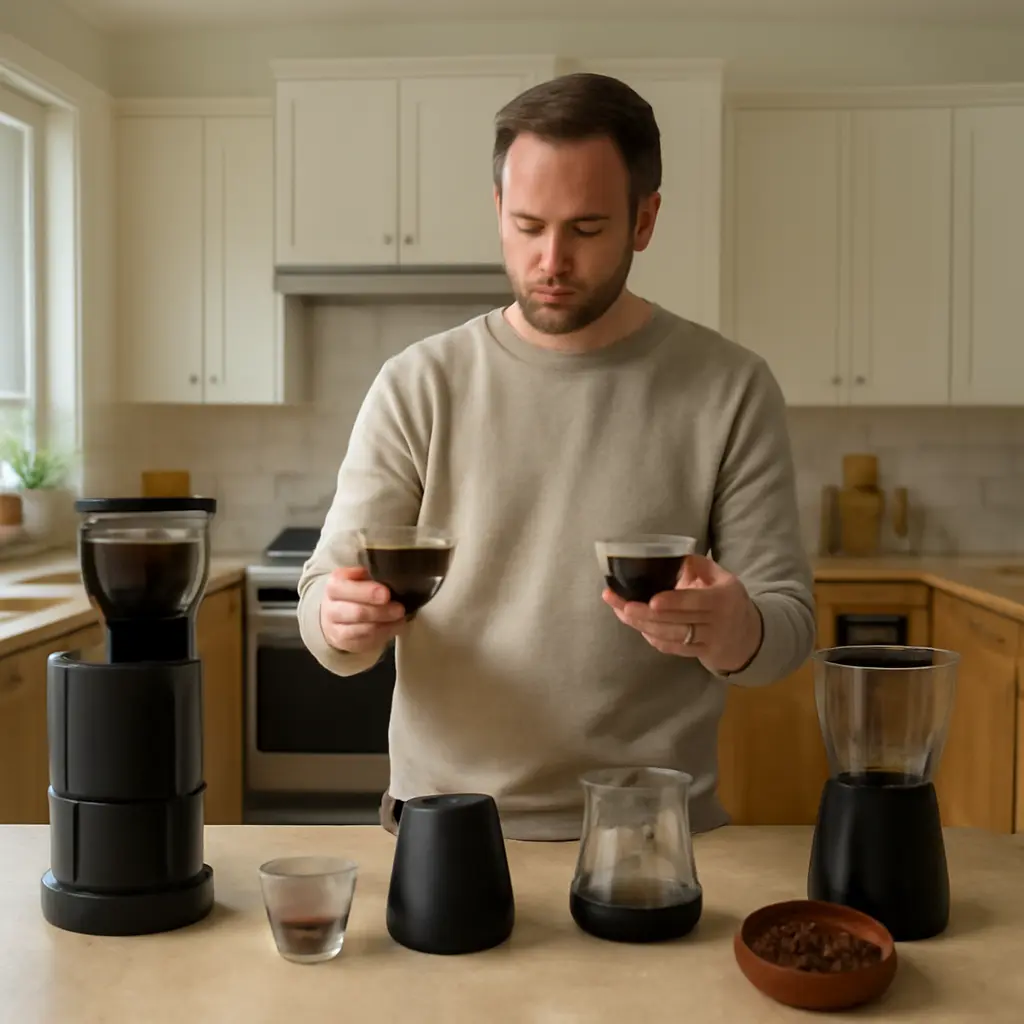
Burr grinders produce more consistent coffee grounds than blade grinders, which is why coffee professionals generally prefer burrs for dialing in espresso and making repeatable brews. Blade grinders are usually cheaper and can work for basic brewing, but their chopping action creates a wider mix of particle sizes. That difference matters: grind consistency affects extraction, while the best choice also depends on brewing method, budget, convenience, and how much control a drinker wants.
Grind consistency explains the blade-versus-burr preference
A coffee grinder’s central job is to reduce roasted beans to particles suited to a brewing method. Burr grinders use two abrasive surfaces—a pair of flat discs or conical components—to crush beans through a set gap. Blade grinders use a rapidly spinning blade to chop beans. Coffee researchers and professional brewers often favor burr grinders because their adjustment mechanism makes it easier to produce a target grind and repeat it.
The distinction is not that every burr grinder makes perfectly uniform grounds or that every blade grinder makes unusable coffee. Both designs produce a distribution of particle sizes. The practical difference is that burr grinders generally offer more controlled particle-size adjustment, while blade grinders tend to leave a less predictable mixture of fine particles and larger fragments.
Particle-size distribution and extraction
Particle-size distribution describes the range of ground-coffee sizes in a dose. Smaller particles expose more surface area to water and extract faster; larger particles extract more slowly. When a grind contains a broad mix, some coffee can become over-extracted while other parts remain under-extracted. Researchers Christopher Hendon and Maxwell Colonna-Dashwood explain in Water for Coffee that brewing outcomes depend on interacting variables, including grind size, water chemistry, temperature, and contact time.
This is why consistency matters especially when a brewer is adjusting a recipe. If the grind changes unpredictably from one batch to the next, it becomes harder to tell whether a change in taste came from grind setting, dose, water, or technique. A burr grinder does not eliminate those variables, but it generally makes grind adjustment more repeatable.
The expert preference—and its limits
Coffee professionals commonly choose burr grinders for espresso, café service, and carefully controlled filter brewing because those uses reward fine adjustment and repeatability. The preference is strongest where small changes in grind can alter flow and extraction. It is not a universal rule that the most expensive burr grinder makes the best coffee: burr geometry, alignment, motor performance, build quality, and the user’s recipe all matter.
For a low-cost, occasional cup, a blade grinder may be an acceptable compromise. For a drinker seeking consistent results, especially with espresso or pour-over, a well-made burr grinder is usually the more useful tool. The relevant comparison is therefore not simply “burr good, blade bad,” but how well each grinder serves the brewing method and the user’s priorities.
Burr grinder types offer different strengths
Burr grinders are defined by the way their paired grinding surfaces reduce beans and by the mechanisms that set the distance between those surfaces. The two principal burr types are flat and conical. Both can produce excellent coffee; neither design guarantees quality without sound engineering and appropriate adjustment.
Flat burrs
Flat burr grinders use two ring-shaped discs with opposing cutting surfaces. Beans pass between them and are ground as they move through the burrs. Coffee professionals often value flat-burr designs for their potential to produce a focused, repeatable grind profile, particularly in espresso settings. Performance still varies by burr design, alignment, grinder construction, and the chosen setting.
Conical burrs
Conical burr grinders pair a cone-shaped inner burr with an outer ring. They are common in both home and commercial grinders and are available in manual and electric models. A conical design can be compact and practical, but the label alone does not determine whether a grinder is quiet, fast, durable, or consistent. Those qualities depend on the complete grinder, not just the burr shape.
Manual and electric burr grinders
Manual burr grinders use a hand crank; electric versions use a motor. Manual models can provide a relatively affordable route to burr grinding and suit small batches, though grinding takes physical effort and time. Electric models prioritize speed and convenience. For either type, useful buying considerations include a stable adjustment mechanism, suitable grind range, easy cleaning, and reliable construction.
These burr categories describe how coffee is ground, while the brewing method determines what grind range and level of control are useful. That makes the comparison with blade grinders clearest when considered through actual brewing applications.
Brewing method determines how much grind control matters
Grind size is matched to how water moves through coffee and how long it remains in contact with it. The Specialty Coffee Association’s brewing guidance treats grind, brew ratio, time, temperature, and water quality as connected variables rather than isolated settings. A grinder that allows controlled adjustment can therefore make it easier to tune a recipe.
Espresso
Espresso uses a fine grind and pressurized water, so small changes in grind can noticeably affect how quickly a shot flows. Burr grinders are the clear practical choice for most espresso preparation because they offer finer, more repeatable adjustment. A blade grinder cannot reliably set a specific espresso grind, making it difficult to correct a shot that runs too quickly or too slowly.
Pour-over and other filter brewing
Pour-over, drip, and similar filter methods benefit from a grind that supports a suitable flow rate and extraction. Burr grinders help brewers make repeatable adjustments when a cup tastes too weak, bitter, or uneven. A blade grinder can still produce grounds for a basic filter brew, but its particle mixture can make results less predictable.
French press and immersion brewing
French press and other immersion methods typically use a coarser grind than espresso. Their longer steeping time and immersion format can be more forgiving of modest variation, so a blade grinder may be adequate for casual use. However, a broad mixture of fine particles can pass through a press filter and contribute to a muddier cup or extra sediment.
Blade grinders trade control for low cost and simplicity
A blade grinder is a small appliance in which a rotating blade chops beans in a chamber. Many models are inexpensive and straightforward to use, but most do not provide a calibrated grind setting. Users often change the result by grinding for more or less time, a method that offers limited precision and can be difficult to reproduce.
Why blade-ground coffee can be uneven
The blade cuts beans wherever they encounter it rather than passing them through a defined burr gap. As a result, a batch may contain both fine dust and larger pieces. Grinding longer may reduce the size of many pieces, but it can also produce more fines without making the overall distribution uniform. That variability can complicate extraction and flavor consistency.
When a blade grinder is a reasonable choice
A blade grinder can make sense when affordability, compact storage, or occasional use matters more than precision. It may suit a drinker making simple filter coffee or immersion coffee who is comfortable with some variation. To improve consistency, users can grind in short pulses, gently shake the grinder between pulses, and avoid grinding more coffee than needed. These techniques may help distribute the chop, but they do not turn a blade grinder into a burr grinder.
A practical comparison helps match grinder to drinker
The following comparison summarizes the typical trade-offs. It is a category-level guide, not a guarantee about every model: a poorly built burr grinder can disappoint, while a blade grinder may be perfectly serviceable for a simple routine.
| Factor | Burr grinder | Blade grinder |
|---|---|---|
| Grind adjustment | Usually adjustable through a set burr gap | Usually controlled mainly by grinding time |
| Repeatability | Generally better when the grinder is well made and adjusted | Generally less predictable between batches |
| Typical cost and convenience | Ranges from affordable manual models to costly electric machines | Often inexpensive, compact, and simple to operate |
| Best fit | Espresso, recipe adjustment, and repeatable brewing | Occasional or budget-focused brewing where precision is less important |
Buying priorities beyond burr type
A sensible purchase starts with the brewing method, then considers budget, convenience, and maintenance. Espresso drinkers should prioritize a grinder designed for fine adjustment. Filter-coffee drinkers may prefer a model with a useful range of settings and easy cleaning. Anyone comparing burr grinders should also look at construction and adjustment stability rather than assuming that “flat” or “conical” alone signals superior performance.
Freshly ground coffee is another practical consideration. The National Coffee Association describes whole-bean coffee as best stored in an airtight, opaque container in a cool, dark place, and recommends grinding shortly before brewing. A grinder’s benefit is therefore tied not only to its mechanism but also to using fresh beans and storing them well.
Conclusion: burrs suit precision, blades suit simplicity
Coffee experts generally prefer burr grinders because their adjustable grinding surfaces provide more control and repeatability than a blade’s chopping action. Flat and conical burrs are both established designs, while manual and electric models serve different budgets and routines. For espresso and brewers who want to tune recipes, burr grinding is the stronger choice; for occasional, budget-conscious brewing, a blade grinder can remain a workable option.
The broader lesson is that grind consistency is one part of brewing, alongside water, dose, temperature, and time. Choose a grinder that fits your brewing method, then adjust one variable at a time and compare the results. For further reading, consult the Specialty Coffee Association’s brewing resources and coffee-science references such as Water for Coffee.
Sources: Specialty Coffee Association, Brewing Standards and Resources, https://sca.coffee/research/protocols-best-practices; Christopher H. Hendon and Maxwell Colonna-Dashwood, Water for Coffee, 2015, https://www.waterforcoffee.com/; National Coffee Association, How to Store Coffee, https://www.ncausa.org/About-Coffee/How-to-Store-Coffee